More than 100 million users depend on Miro, the collaboration layer for the age of AI that brings teams, AI agents, and systems of record together. Clients include Endava, J.Crew Group, PepsiCo and Ubisoft. The brand team behind the platform is a group of 11 people supporting everything Miro puts into the world. That team has spent the past year building toward an AI-native production model, including a suite of internal tools that shape how briefs get translated into finished work. Antoine Levi, Miro's Production Lead, shapes how projects come together from brief to delivery. Pol O'Callaghan, a motion designer, is a hands-on builder, the one designing and building each piece from concept to final frame. Together, they help lead the creative projects that define how Miro shows up in the world.
Most recently, that meant building a sizzly intro video for Canvas26, Miro's annual event, entirely with Runway that was then localized across 4 different cities. In this conversation, they talk through how the project came together, what changed when they stopped relying on stock footage, and where Runway now fits in the team's day-to-day work.
Rethinking a Recurring Brief
How does the Brand team at Miro work, and what's the creative philosophy behind it?
AL: We’re a small, multidisciplinary team of 11 creative generalists, bringing different skills together under one creative remit. We partner with teams across Miro to turn business needs and ideas into the right creative solutions.
The culture at Miro is pro-experimentation, especially in brand and creative. There's a company-wide push to embrace the potential of AI, and we're at the forefront of that. We're expected to push into new territory, not just execute briefs. That's what put us in the position where we could proactively propose something like using AI for the annual keynote video.
The Canvas intro video is a recurring piece for Miro. What made this year different?
AL: Canvas is our annual global event. The intro video opens the day’s programming and needs to set the energy for the room.
In previous years, we used stock footage with 3D motion design elements layered on top. This year, we were launching major updates to our AI capabilities, so it made sense to leverage AI for the intro video that preceded it all.
Creating Every Shot in Runway
You'd already worked with Runway on other content before this. How did that experience shape how you approached building the Canvas video?
AL: We had been experimenting with developing fully AI ads. A lot of our learning from that project was about translating the instincts you build on real shoots into an AI production context: casting, directing and thinking in shots. That carried directly into how we approached the Canvas video.
PO: Every shot in the Canvas video, every cityscape, every crowd, every shot of people entering a venue, originated in Runway. The motion design and brand elements are layered on top, but the underlying footage is all Runway.
There’s a capability in Miro called Flows that makes everyday workflows visible and collaborative on the canvas. We wanted to visually reference Flows’ nodes and connector lines, so I built a 3D version of it and layered it into the AI-generated shots. The motion design work sits on top of all of that: white line effects, the countdown sequence.
For each shot, I ran through tens of static image iterations first until I generated something high quality. Then came many, many iterations until I had the specific video I wanted.
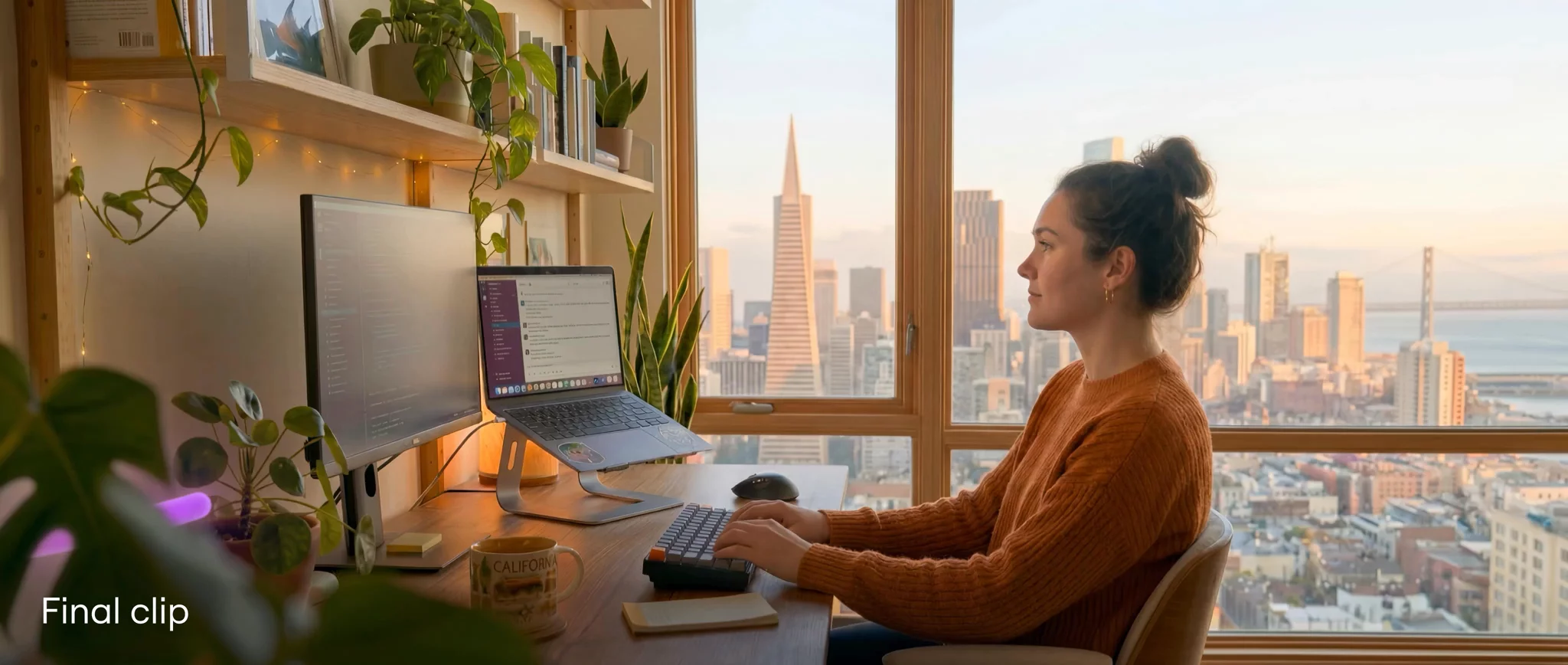
AL: The venue shots required extra attention. The event ran across four cities, and we created an opening video tailored to each. For the final sequence, we needed a cinematic pull of people entering the actual event venue, accurate to the location. We used photos of the venues as reference images in Runway and generated the shots from those.
“Every shot in the Canvas video, every cityscape, every crowd, every shot of people entering a venue, originated in Runway. The motion design and brand elements are layered on top, but the underlying footage is all Runway.”
How did working with Runway's team shape how the broader team uses the product?
PO: We worked with forward deployed creatives from Runway, and they ran dedicated sessions with us. It helped the team build confidence with the platform and get a real sense of how it worked: understanding model strengths and weaknesses, how to select the right model for the task, what makes a good image reference and what doesn't.
This support gave us a foundation we could actually build on and unlocked a lot of potential. It made the Canvas26 project possible at the level we executed it at.
What’s Next for Miro
What has Runway changed about how you work?
PO: Runway has helped us move faster at a fidelity we want. For this project, it was important to have the exact shots we wanted. The output is the shot you actually want, not the closest thing a stock library has available. You can't find a cinematic pull of people entering a specific event venue in San Francisco in a stock library.
AL: And for the Canvas project, for example, there were finer details. We needed wide views for the projection screens, non-standard aspect ratios that stock libraries don't reliably carry at quality. Even in 4K, cropping to our format would have lost resolution. Runway let us generate natively at the dimensions we needed.
“The output is the shot you actually want, not the closest thing a stock library has available.”
Where does Runway fit into the team's work now?
PO: The way I'd describe it: we do our usual projects, and whenever we need extra footage, we default to Runway. That runs in parallel with bigger experimental projects like Rome in a Day and the sequel we're working on now.
AL: What's also changed is who can be involved in the creative process. Our creative team can suggest and generate imagery that is implemented directly in our shots. The end-to-end process is able to remain in one tool, which keeps everything consistent.
原始发布方:Runway:News(网页)
原文时间:2026-09-01 00:00:00 +08:00